
Pediatric
Newborn Care
Gentle evaluation
designed around your newborn's needs.
When feeding, positioning, or settling concerns arise, a careful examination can help determine whether musculoskeletal tension may be contributing.
Serving Whitefish and the Flathead Valley.

The clinical picture
Persistent symptoms have a cause — and it can be identified.
These observations are worth evaluating promptly: they are objective, they have identifiable mechanical causes, and they respond well to gentle care in the first months of life. A focused pediatric examination determines whether tension is present and whether it is contributing to what you're seeing.
The first few weeks
What newborn care typically feels like day to day.
- Strong head-turn preference to one side
- Difficulty latching or nursing well on one side
- Flattening on one side of the head
- Arching, stiffening, or pulling away when laid down
- Tummy time turns into crying within a minute
- Won't settle in the car seat or bassinet
What this means over time
When early patterns go unaddressed, they tend to entrench: head-shape flattening, persistent feeding difficulty, and milestone delays become harder to resolve with each passing month. The window for gentle correction in the first few months is wide — which is why an evaluation is worthwhile even when you've been advised to simply wait and see.
Untreated newborn tension patterns often turn into persistent torticollis, flat-head shape that needs a helmet, prolonged feeding struggles, and delayed milestones like rolling and crawling. Most of these patterns respond beautifully when addressed in the first few months — and get harder to unwind the longer they go on.
A precise evaluation is the starting point.
Dr. Smith's examination identifies the specific structures involved, measures how they're functioning, and determines — honestly — whether our care is the right fit for what you're dealing with.
Caregiver observations
Changes families commonly report.
- Baby always sleeps facing the same direction
- One side of the head is rounder than the other
- Nursing is calm on one side and a battle on the other
- They cry the second they go flat on their back
- Their neck looks tilted in photos and nobody mentioned it
Causes & clinical context
Understanding what may contribute to newborn care.
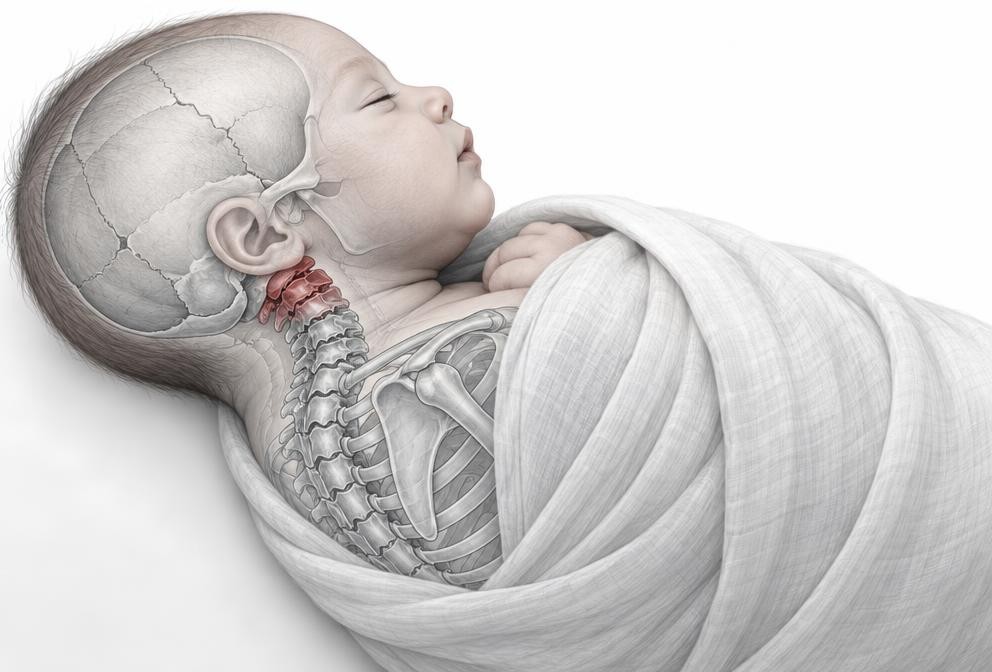
Common underlying causes
- Long, fast, or assisted labor (vacuum, forceps, C-section)
- Position in the womb in the final weeks of pregnancy
- Cervical and cranial tension from the birth process
- Latch and feeding-side compensations
What's usually offered — and where it falls short
Wait and see / 'they'll grow out of it'
Limit: Sometimes works. Often the head-shape, feeding side, or torticollis pattern entrenches in weeks two through eight when gentle care could have resolved it.
Helmet therapy for flat spots
Limit: Addresses the shape after the fact without resolving the underlying neck tension that caused baby to keep turning the same direction.
Stretching exercises from a handout
Limit: Helpful as a piece of the picture — but rarely enough on their own when there's real upper-cervical or cranial tension in the way.
Evaluation and care
A plan based on the findings.
- A focused history and examination
- Orthopedic and neurologic screening when indicated
- Care matched to the structures and functional findings involved
- Objective reassessment with referral when appropriate
What to expect
First visit
Examination, findings, and a clear recommendation for the appropriate next step.
During care
Symptoms and function are tracked so the plan can be adjusted as needed.
Reassessment
Progress is measured rather than assumed, with referral when goals are not being met.
How Dr. Smith treats this differently
Our Newborn Care approach for Newborn Care.
Light-touch chiropractic care designed for newborns — supporting recovery from birth, easing head-turn preferences and torticollis, and helping with latching, sleeping, and settling.
Explore the Newborn Care ProgramCommon Questions
Frequently Asked Questions
Stop living around newborn care.
Start with a $47 new patient evaluation and we'll tell you honestly whether we can help.