
Joint
Shoulder Pain
Reaching and lifting
should not require constant compensation.
Shoulder symptoms can interfere with sleep, work, dressing, and recreation. Identifying the involved tissue is the first step toward appropriate care.
Serving Whitefish and the Flathead Valley.

The clinical picture
Persistent symptoms have a cause — and it can be identified.
Many patients have already tried rest, ice, or a cortisone injection with only temporary relief. What's usually missing is an examination that identifies the specific tissue involved and a plan that restores proper mechanics rather than simply quieting the pain.
The reach test
What shoulder pain typically feels like day to day.
- Pain reaching overhead, behind your back, or across your body
- Trouble sleeping on the affected side
- Putting on a coat or fastening a bra becomes a strategy
- Weakness lifting groceries or grandchildren
- Wincing on reaches you used to do without thinking
What this means over time
Loss of shoulder function affects independence in concrete ways: dressing, lifting, carrying, and reaching all become difficult. Concern about a worsening tear or a progressive 'frozen' shoulder is legitimate — these conditions do advance when the underlying mechanics are never addressed. A precise diagnosis is the first step toward preventing that.
Shoulders that hurt get used less. Used less, they get weaker and stiffer, and the rotator cuff compensates with smaller and smaller patterns until full range is gone. A 'frozen' shoulder almost always started as a sore one that nobody addressed.
A precise evaluation is the starting point.
Dr. Smith's examination identifies the specific structures involved, measures how they're functioning, and determines — honestly — whether our care is the right fit for what you're dealing with.
Causes & clinical context
Understanding what may contribute to shoulder pain.
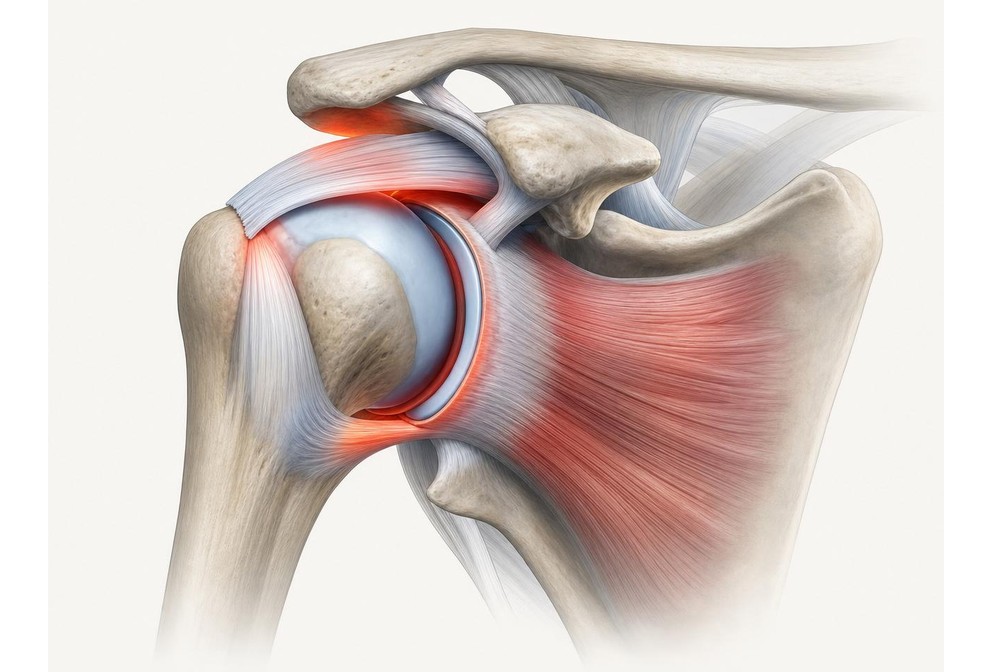
Common underlying causes
- Rotator-cuff irritation or partial tearing from repetitive overhead use
- Joint impingement as the rotator cuff gets pinched under the shoulder blade
- Postural strain from years of desk work or forward-rounded shoulders
- Tendon and bursa inflammation that compounds with every flare
- Capsular tightness ('frozen' shoulder) restricting normal motion
What's usually offered — and where it falls short
Cortisone injections
Limit: Often calm inflammation for weeks to months without changing the mechanics that caused it — and repeated injections weaken the surrounding tendon.
Arthroscopic 'clean-up' surgery
Limit: Has a real place for true structural tears, but is frequently offered before non-surgical mechanics, decompression, and tissue stimulation have had a fair trial.
Generic 'rest and ice'
Limit: A shoulder that hurts almost always needs targeted motion, not avoidance. Pure rest accelerates stiffness and weakness.
Evaluation and care
A plan based on the findings.
- A focused history and examination
- Orthopedic and neurologic screening when indicated
- Care matched to the structures and functional findings involved
- Objective reassessment with referral when appropriate
What to expect
First visit
Examination, findings, and a clear recommendation for the appropriate next step.
During care
Symptoms and function are tracked so the plan can be adjusted as needed.
Reassessment
Progress is measured rather than assumed, with referral when goals are not being met.
How Dr. Smith treats this differently
Our Shoulder Therapy approach for Shoulder Pain.
A structured non-surgical shoulder program combining shockwave therapy, joint mobilization, and rotator-cuff rehab to restore reach, strength, and side-sleeping.
Explore the Shoulder Therapy ProgramCommon Questions
Frequently Asked Questions
Stop living around shoulder pain.
Start with a $47 new patient evaluation and we'll tell you honestly whether we can help.