
Spine
Herniated or Bulging Disc
A disc finding is important,
but it is only part of the clinical picture.
Disc-related symptoms can vary widely. Your examination should connect the imaging, movement findings, and symptom pattern before care is recommended.
Serving Whitefish and the Flathead Valley.

The clinical picture
Persistent symptoms have a cause — and it can be identified.
An MRI finding is a starting point, not a treatment plan. What matters is an examination that correlates your imaging with your actual symptoms and determines whether non-surgical decompression is appropriate for your case.
What the MRI doesn't tell you
What herniated or bulging disc typically feels like day to day.
- Deep, achy back or neck pain that gets worse the longer you sit
- Sharp jolts with coughing, sneezing, or bending
- Pain, numbness, or tingling radiating into an arm or leg
- Morning stiffness that takes 20 minutes to ease
- Trouble lifting anything in front of you
What this means over time
A disc diagnosis raises understandable questions: whether surgery is unavoidable, whether symptoms will progress, and what long-term limitation looks like. In reality, most disc injuries respond to structured non-surgical care when compression and mechanics are addressed before degeneration advances. An honest reading of your imaging — paired with a clear plan — replaces that uncertainty with a defined path.
Discs that stay compressed lose more height, dehydrate further, and load the joints around them in ways those joints were never built for. What started as one bad segment quietly becomes a multi-level degenerative pattern — and surgical options narrow as it spreads.
A precise evaluation is the starting point.
Dr. Smith's examination identifies the specific structures involved, measures how they're functioning, and determines — honestly — whether our care is the right fit for what you're dealing with.
Causes & clinical context
Understanding what may contribute to herniated or bulging disc.
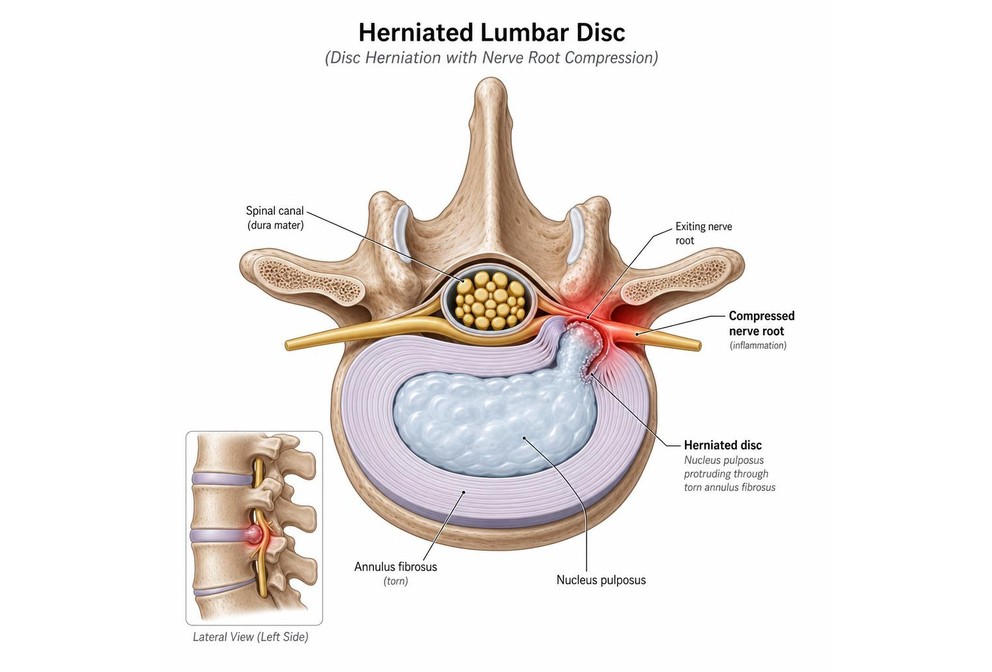
Common underlying causes
- A bulging or herniated disc pressing on surrounding tissue
- Degenerative disc disease and disc dehydration
- Years of compressive load from sitting, lifting, or postural overload
- Loss of core and hip stability that keeps overloading the disc
- Previous injury that never fully resolved
What's usually offered — and where it falls short
Pain medication and muscle relaxers
Limit: Quiet the alarm without releasing pressure on the disc itself — and long-term use carries its own risks.
Epidural steroid injections
Limit: Reduce inflammation around the nerve for weeks to months without changing the mechanical load on the disc.
Surgery (microdiscectomy, fusion)
Limit: Has a real place for clear neurological emergencies, but is frequently offered before non-surgical decompression has been given a structured trial.
Evaluation and care
A plan based on the findings.
- A focused history and examination
- Orthopedic and neurologic screening when indicated
- Care matched to the structures and functional findings involved
- Objective reassessment with referral when appropriate
What to expect
First visit
Examination, findings, and a clear recommendation for the appropriate next step.
During care
Symptoms and function are tracked so the plan can be adjusted as needed.
Reassessment
Progress is measured rather than assumed, with referral when goals are not being met.
How Dr. Smith treats this differently
Our Disc Treatment approach for Herniated or Bulging Disc.
Disc-specific spinal decompression, anti-inflammatory care, and stabilization rehab for bulging, herniated, or degenerative discs in the low back or neck.
Explore the Disc Treatment ProgramCommon Questions
Frequently Asked Questions
Stop living around herniated or bulging disc.
Start with a $47 new patient evaluation and we'll tell you honestly whether we can help.