
Head & Balance
Vertigo & Dizziness
Dizziness requires
careful screening before treatment.
The timing, triggers, and accompanying symptoms help distinguish neck-related dizziness from inner-ear, cardiovascular, neurologic, and medication-related causes.
Serving Whitefish and the Flathead Valley.

The clinical picture
Persistent symptoms have a cause — and it can be identified.
Vertigo and dizziness are symptoms, not a single diagnosis. The priority is recognizing the pattern and referring promptly when findings suggest an inner-ear, cardiovascular, neurologic, or medication-related cause.
Recognizing the pattern
What vertigo & dizziness typically feels like day to day.
- A spinning or moving sensation
- Unsteadiness or veering
- Symptoms with head or neck movement
- Dizziness accompanied by neck pain
- Nausea, visual disturbance, or lightheadedness
What this means over time
Dizziness can reduce confidence with driving, stairs, work, and uneven ground. A conservative screening process is more important than assuming every episode has the same cause.
Some causes are benign, while others require urgent treatment. Sudden dizziness with facial droop, slurred speech, double vision, severe headache, chest pain, or one-sided weakness is an emergency.
A precise evaluation is the starting point.
Dr. Smith's examination identifies the specific structures involved, measures how they're functioning, and determines — honestly — whether our care is the right fit for what you're dealing with.
Causes & clinical context
Understanding what may contribute to vertigo & dizziness.
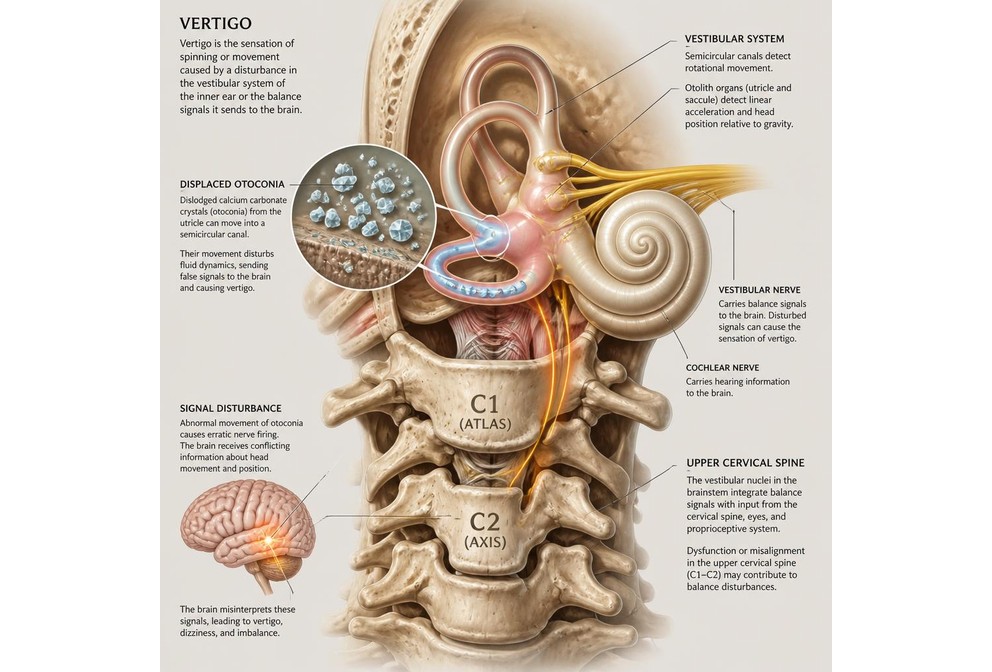
Common underlying causes
- Inner-ear conditions
- Blood-pressure or medication effects
- Neurologic or cardiovascular causes
- Migraine-associated dizziness
- Cervicogenic dizziness in selected cases
What's usually offered — and where it falls short
Treating every case as inner-ear vertigo
Limit: Dizziness can arise from several systems and requires differential screening.
Assuming the neck is always the cause
Limit: Neck-related dizziness is only one possible pattern and should be considered after appropriate screening.
Evaluation and care
A plan based on the findings.
- History and safety screening
- Neurologic, balance, and neck examination
- Medical, ENT, or vestibular referral when indicated
- A short trial of conservative neck care only when findings support it
What to expect
First visit
Screening may lead to referral rather than treatment.
If neck-related
A short, defined trial of care is reassessed objectively.
How Dr. Smith treats this differently
Our Chiropractic approach for Vertigo & Dizziness.
Specific, exam-driven chiropractic care for the spine and extremities — chosen based on what your body actually needs, not a routine.
Explore the Chiropractic ProgramCommon Questions
Frequently Asked Questions
Related conditions
Clinical note: Sudden dizziness with facial droop, slurred speech, double vision, severe headache, chest pain, fainting, or one-sided weakness is a medical emergency. Call 911.
Stop living around vertigo & dizziness.
Start with a $47 new patient evaluation and we'll tell you honestly whether we can help.