
Foot & Ankle
Achilles Tendonitis
Build back the capacity
to walk, climb, and push off comfortably.
Achilles tendon pain often follows a change in activity or repeated loading. Screening the tendon and surrounding mechanics helps guide safe progression.
Serving Whitefish and the Flathead Valley.

The clinical picture
Persistent symptoms have a cause — and it can be identified.
Achilles pain commonly develops when training load increases faster than the tendon can adapt. A sudden pop, bruising, or inability to push off suggests a possible rupture and changes the care pathway.
Recognizing the signs
What achilles tendonitis typically feels like day to day.
- Morning stiffness at the back of the ankle
- Pain during running, hiking, or stairs
- Tenderness or thickening in the tendon
- Reduced push-off strength
- Symptoms after a sudden increase in activity
What this means over time
Achilles pain can quickly limit running, hiking, skiing, and ordinary walking. Recovery depends on restoring tendon load tolerance rather than simply waiting for pain to disappear.
Continuing to overload an irritable tendon may prolong symptoms. A sudden pop with weakness needs urgent evaluation for rupture.
A precise evaluation is the starting point.
Dr. Smith's examination identifies the specific structures involved, measures how they're functioning, and determines — honestly — whether our care is the right fit for what you're dealing with.
Causes & clinical context
Understanding what may contribute to achilles tendonitis.
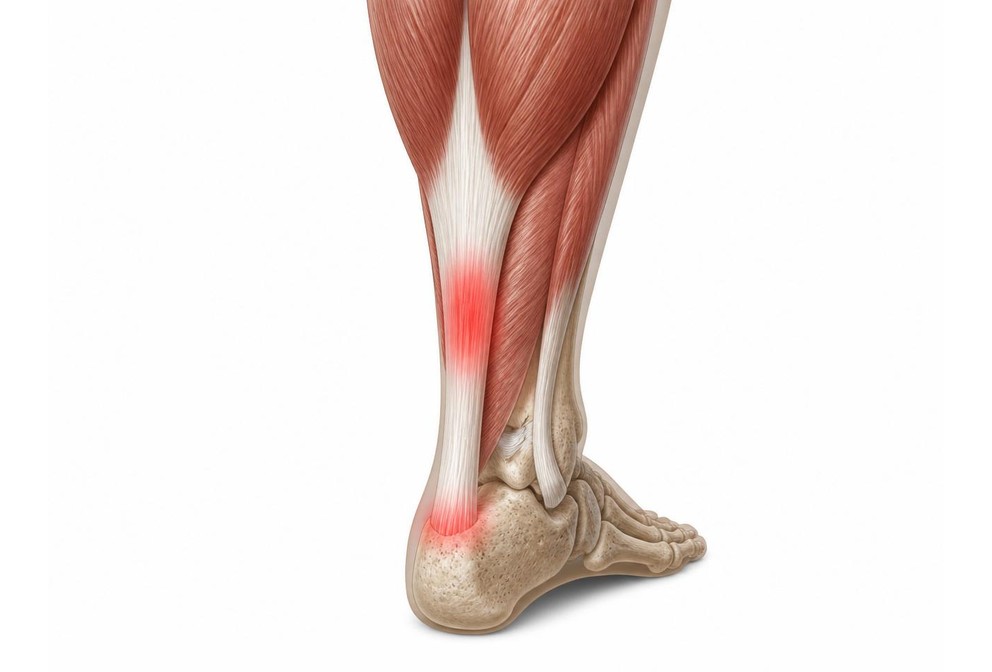
Common underlying causes
- Rapid increase in training volume
- Reduced calf strength or ankle mobility
- Hill or speed work
- Footwear or surface change
- Age-related tendon change
What's usually offered — and where it falls short
Complete rest
Limit: May calm pain but does not rebuild tendon capacity.
Stretching alone
Limit: Can aggravate some insertional symptoms and is not a complete loading program.
Evaluation and care
A plan based on the findings.
- Rupture and movement screening
- Shockwave therapy for appropriate chronic tendinopathy
- Progressive calf loading
- Activity and training modification
What to expect
First visit
A focused history and examination identify the likely source and screen for findings that need referral.
Early care
Treatment is matched to the exam findings, with symptoms and function tracked rather than assumed.
Reassessment
Progress is measured and the plan is continued, changed, or referred when appropriate.
How Dr. Smith treats this differently
Our Shockwave Therapy approach for Achilles Tendonitis.
FDA-cleared shockwave technology used to stimulate tissue repair in tendons, joints, and the plantar fascia — without injections, drugs, or downtime.
Explore the Shockwave Therapy ProgramCommon Questions
Frequently Asked Questions
Related conditions
Clinical note: A sudden pop, significant bruising, or inability to push off may indicate rupture and requires urgent medical evaluation.
Stop living around achilles tendonitis.
Start with a $47 new patient evaluation and we'll tell you honestly whether we can help.