
Joint
Arthritis
Joint changes do not automatically mean
giving up the activities you value.
Arthritis can create stiffness, reduced motion, and recurring discomfort. Conservative care focuses on the factors that can still improve.
Serving Whitefish and the Flathead Valley.

The clinical picture
Persistent symptoms have a cause — and it can be identified.
In practice, joint symptoms respond meaningfully when inflammation, mechanics, and the strength of the muscles supporting the joint are addressed together. The relevant question is not whether the wear exists, but whether the joint environment can be improved enough to change how the joint functions.
The weather report
What arthritis typically feels like day to day.
- Morning stiffness that takes 10+ minutes to work out
- Aching joints with cold or rainy weather
- Grinding, clicking, or 'bone-on-bone' sensation with motion
- Pain getting on and off the floor or up from the couch
- Daily NSAID use just to keep moving
What this means over time
Being told to 'live with' arthritis tends to produce a gradually shrinking activity level — fewer long walks, less gardening, more caution on stairs. That decline is not caused by cartilage loss alone; it is the combined effect of untreated inflammation, weakening support muscles, and progressive avoidance. Targeted care addresses all three, which is why function often improves even though the wear itself remains.
Cartilage that's already thinning doesn't thicken on its own. Without targeted care, the joint stiffens further, the muscles around it weaken, and the inflammatory cycle accelerates the wear that's already there. The slow-motion result is the joint replacement and the long recovery that comes with it.
A precise evaluation is the starting point.
Dr. Smith's examination identifies the specific structures involved, measures how they're functioning, and determines — honestly — whether our care is the right fit for what you're dealing with.
Causes & clinical context
Understanding what may contribute to arthritis.
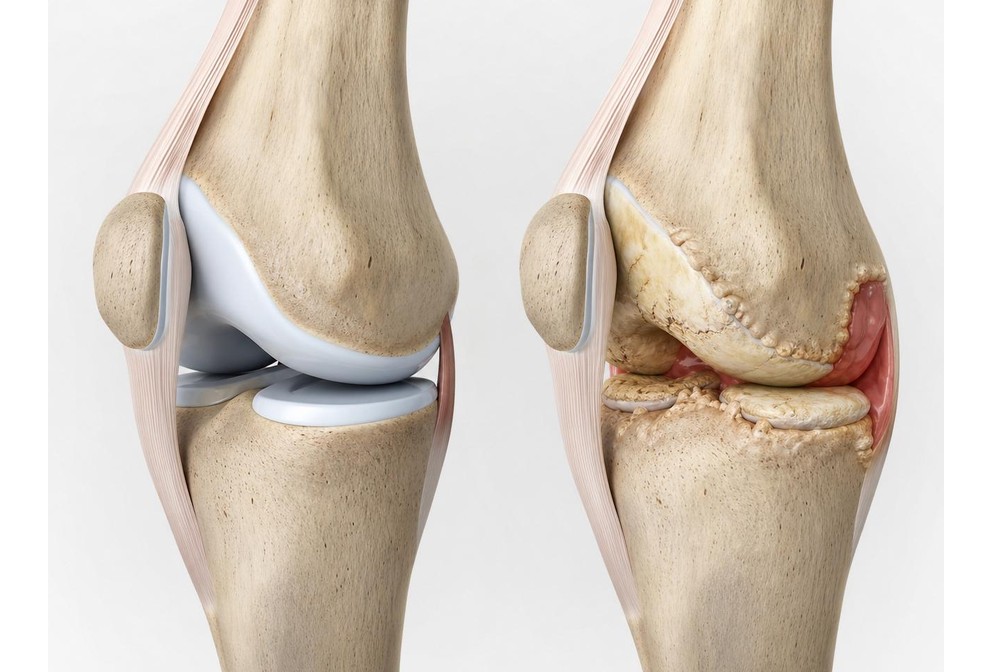
Common underlying causes
- Cumulative cartilage wear from decades of compressive load
- Low-grade systemic inflammation accelerating joint breakdown
- Old injuries that changed how the joint loads and tracks
- Muscle weakness and instability around the joint
- Genetic predisposition combined with lifestyle load on the joint
What's usually offered — and where it falls short
Daily NSAIDs (ibuprofen, naproxen, etc.)
Limit: Lower the pain signal without changing the joint environment — and long-term use is hard on the stomach, kidneys, and heart.
Cortisone injections
Limit: Buy short-term relief but can accelerate cartilage breakdown over time and stop working as the joint deteriorates.
'There's nothing to do until you need a replacement'
Limit: Sells the patient short. Targeted joint mobilization, shockwave, strength, and inflammation guidance routinely change function for people who were told to just wait.
Evaluation and care
A plan based on the findings.
- A focused history and examination
- Orthopedic and neurologic screening when indicated
- Care matched to the structures and functional findings involved
- Objective reassessment with referral when appropriate
What to expect
First visit
Examination, findings, and a clear recommendation for the appropriate next step.
During care
Symptoms and function are tracked so the plan can be adjusted as needed.
Reassessment
Progress is measured rather than assumed, with referral when goals are not being met.
How Dr. Smith treats this differently
Our Arthritis Care approach for Arthritis.
Shockwave therapy, joint mobilization, inflammation guidance, and strength work for knees, hips, shoulders, hands, and spine affected by osteoarthritis.
Explore the Arthritis Care ProgramCommon Questions
Frequently Asked Questions
Stop living around arthritis.
Start with a $47 new patient evaluation and we'll tell you honestly whether we can help.